How to Choose the Right Water Purifier for UAE Tap Water
UAE tap water is technically safe to drink — but it travels through old pipes, carries high mineral content, and often tastes of chlorine. Here’s exactly what purifier your home needs, and the best picks on Amazon UAE & Noon.
📅 Updated March 2025⏱ 10 min read🧪 Research-backed✅ Affiliate links inside
The Truth About UAE Tap Water
The UAE’s tap water supply is one of the most technologically advanced in the world. Almost all of it originates from desalination plants — seawater stripped of salt through reverse osmosis or thermal distillation. By the time it leaves the treatment plant, it meets international WHO standards and is technically safe to drink.
So why do most UAE residents — Emirati and expat alike — refuse to drink it straight from the tap? The answer lies in what happens after the water leaves the plant.
💧 Did You Know
Desalinated water has very low mineral content when it leaves treatment facilities. To prevent it from corroding pipes, municipalities re-mineralise it — often adding calcium and magnesium. By the time it reaches your home, those levels can be significantly elevated depending on your building’s pipe age and material.
The UAE’s rapidly built urban infrastructure means many apartment blocks and villas have old galvanised steel or even lead-lined pipes. Water sitting in rooftop storage tanks under the intense Gulf heat — sometimes reaching 50°C+ — can develop bacterial growth, absorb metallic particles, and lose its chlorine protection. The result: legally safe water, in older buildings, it potentially carries trace contaminants.
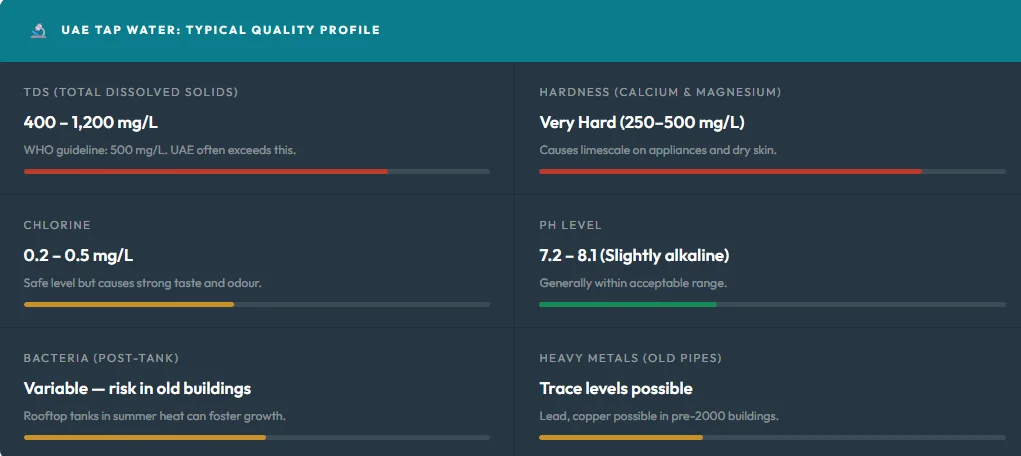
The bottom line: if you live in a newer building (post-2010) in Dubai or Abu Dhabi, your tap water is almost certainly safe and a basic filter will do. If your building is older, or you notice a metallic taste, limescale buildup on taps, or a strong chlorine smell, you need something more powerful.
⚠️ Limescale Warning
UAE’s hard water is a major reason why kettles, steam irons, dishwashers, and coffee machines fail prematurely. A water purifier doesn’t just protect your health — it protects your appliances and can extend their lifespan significantly.
The 4 Main Types of Water Purifiers — Explained
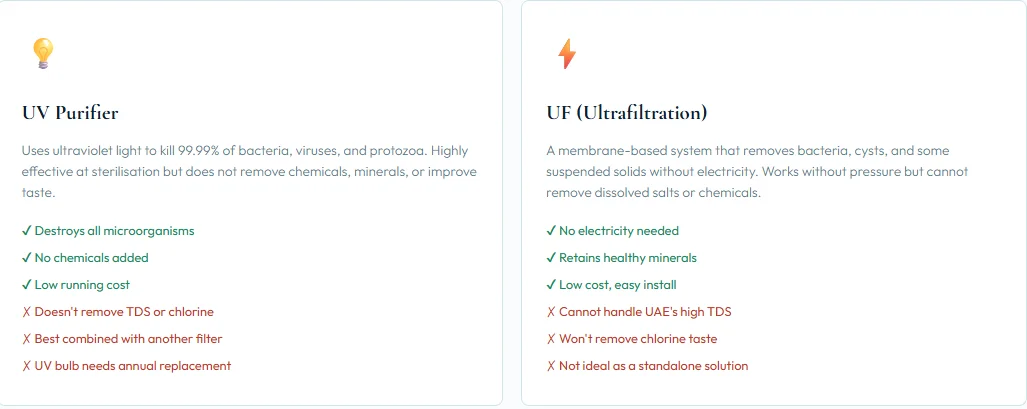
Walk into any Carrefour or browse Amazon UAE, and you’ll find dozens of water purifiers with confusing acronyms. Here’s a plain-English breakdown of the four main technologies and how they perform against the UAE tap water’s specific challenges.
🏆 Best for UAE
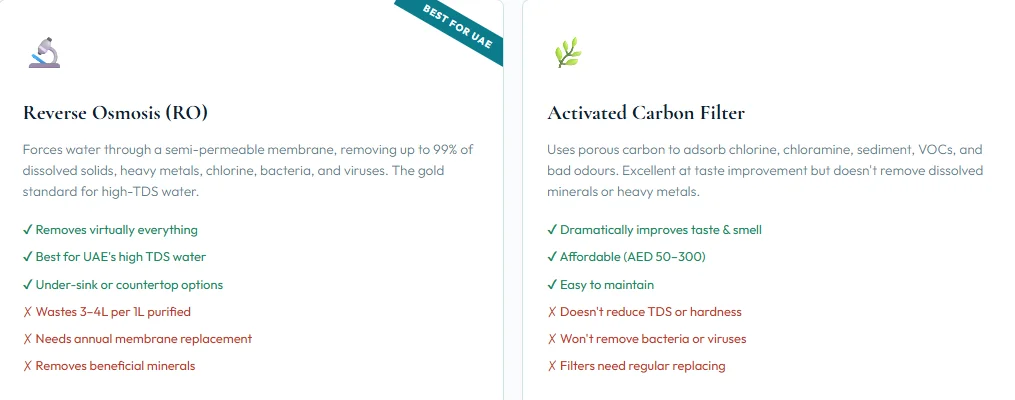
Reverse Osmosis (RO) is the most effective technology for UAE tap water. Given the high TDS levels (often 4–10× the WHO guideline), an RO system tackles every major concern: dissolved salts, limescale minerals, chlorine, heavy metals, and bacteria. Look for RO systems that include a remineralisation stage to add back healthy minerals like calcium and magnesium after filtration.
How to Choose: A Step-by-Step Guide
Before spending a dirham, work through these five questions to identify exactly what you need.
1. Test Your Water First
Buy a TDS meter (available on Amazon UAE for AED 25–60) and test your tap water. A reading under 300 mg/L is acceptable with a carbon filter. 300–600 mg/L warrants an RO system. Above 600 mg/L — very common in older UAE buildings — you need a high-capacity RO unit. You can also request a full water quality report from DEWA (Dubai) or ADDC/AADC (Abu Dhabi).
2. Decide: Under-Sink, Countertop, or Pitcher?
Under-sink RO systems are the most powerful and convenient — they connect directly to your kitchen tap and store purified water in a pressurised tank. Countertop purifiers need no installation but take up worktop space. Pitcher filters (like Brita) are entry-level — good for taste but inadequate for UAE’s high TDS. For families of 3+, an under-sink RO is the best long-term value.
3. Check the Water Pressure in Your Building
Most UAE apartments have water pressure between 40–80 PSI — sufficient for standard RO systems, which typically require a minimum of 40 PSI. Older buildings or top-floor apartments may have lower pressure. If your pressure is below 40 PSI, look for RO systems with a built-in booster pump (models by iSpring, APEC, and Frizzlife include these).
4. Consider Filter Stage Count
Entry-level RO systems have 3–4 stages. For UAE water, we recommend a minimum of 5 stages: sediment pre-filter → activated carbon block → RO membrane → post-carbon polish → remineralisation or alkaline filter. Systems with a 6th UV stage add bacterial protection, particularly valuable if your building has rooftop tanks.
5. Calculate Running Costs
RO membranes need replacing every 12–24 months (AED 60–200). Pre-filters every 6 months (AED 30–80 per set). Compare annual filter costs across brands before buying — some budget systems have expensive proprietary cartridges. Also factor in water waste: UAE water is cheap, but conscious households may prefer efficient 1:1 ratio systems (see picks below).
Top 6 Water Purifiers for UAE Homes in 2025
All picks below are verified as available on Amazon UAE or Noon UAE, come with UAE-compatible voltage (220–240V), and have been selected based on performance against the UAE’s high-TDS, hard water profile.
🏆 Best Overall RO System
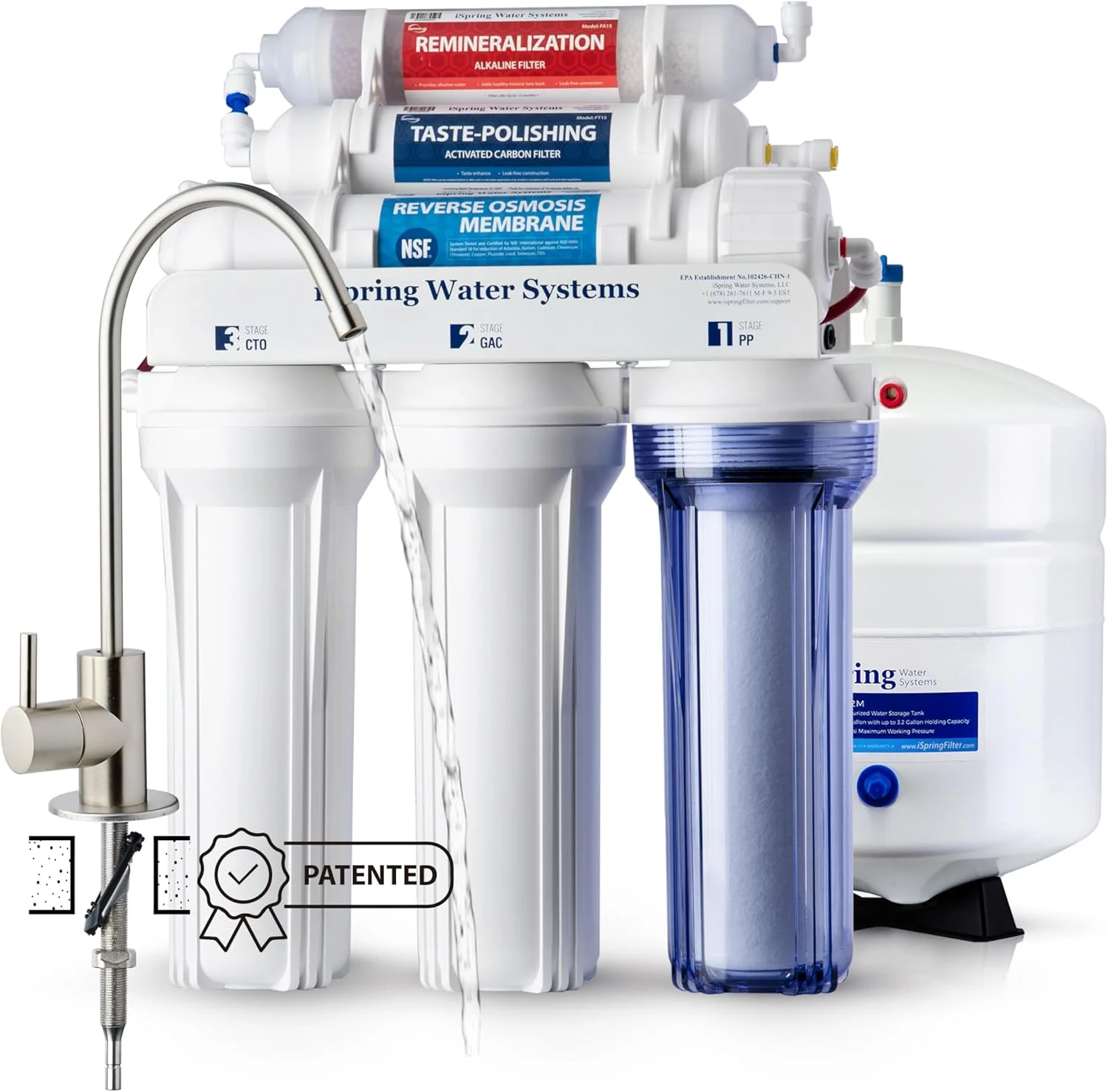
iSpring RCC7AK 6-Stage RO Purifier
75 GPD · 6 stages including alkaline remineralisation · 3.2L storage tank · Reduces TDS by up to 99% · USA-made membrane · 1-year warranty · Under-sink
The iSpring RCC7AK is our top recommendation for UAE households. Its 6-stage filtration is specifically designed for high-TDS, hard water conditions. The standout feature is Stage 6: an alkaline remineralisation filter that adds back healthy calcium, potassium, and magnesium after the RO membrane strips everything out — so you get genuinely clean water that still tastes great and isn’t acidic. The installation kit includes everything needed for a standard UAE under-sink configuration.
AED 1,780: Free Delivery
Amazon UAE
💧 Best Tankless / Smart RO
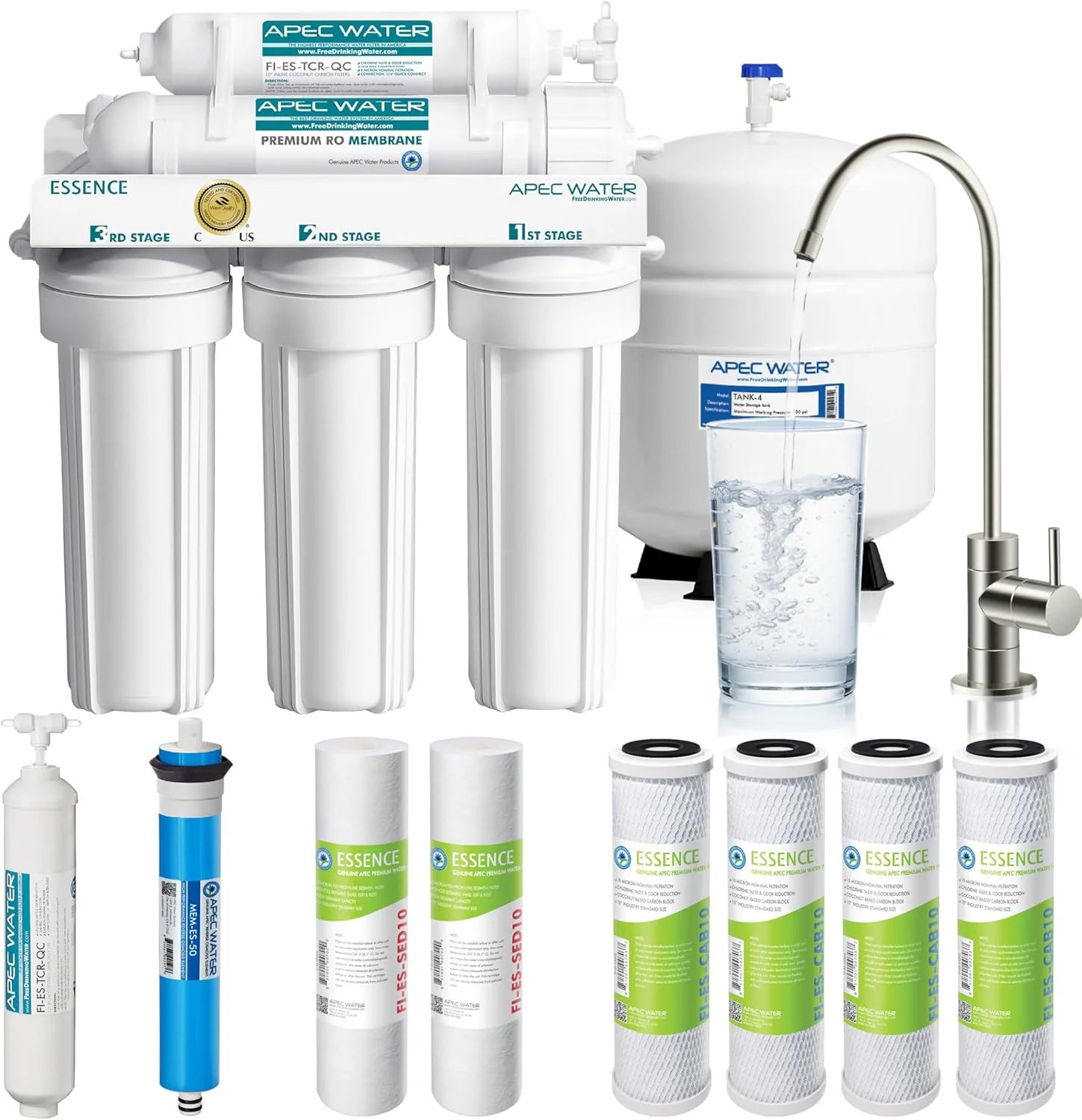
APEC Water Systems ROES-50 + Frizzlife PD600
600 GPD · Tankless design · 1.5:1 pure-to-drain ratio · Real-time TDS display · App control · 5-stage filtration · Under-sink · Smart leak detector included
Tankless RO systems eliminate the pressurised storage tank, meaning water is purified on demand rather than stored. The Frizzlife PD600 produces 600 gallons per day — far more than a family could ever use — and its 1.5:1 efficiency ratio means far less water waste than traditional RO systems. The built-in TDS display lets you monitor water quality in real time, which is particularly reassuring in UAE buildings with variable water quality.
AED 1,698: Free Delivery
Amazon UAE
💰 Best Value Under AED 600
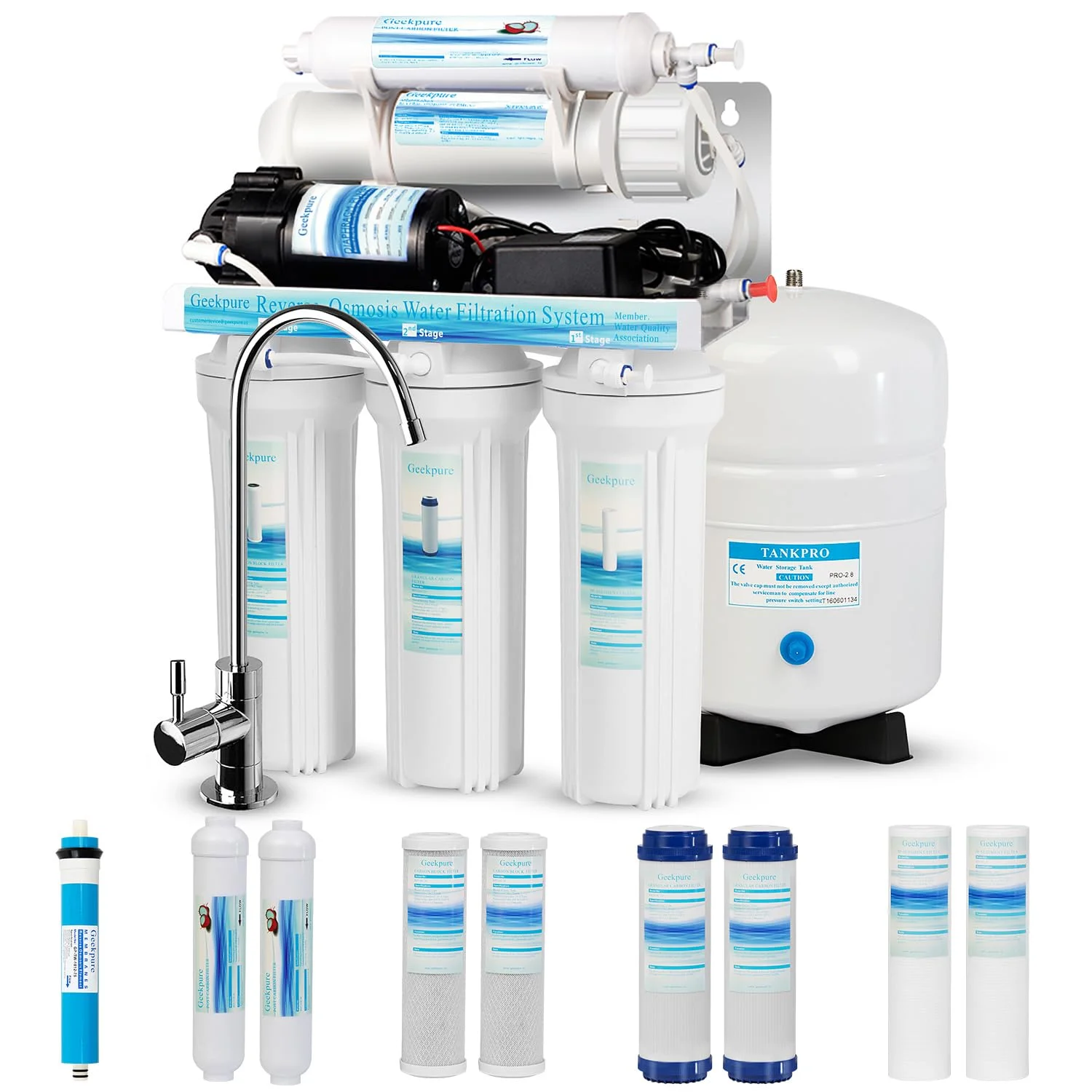
Geekpure 5 Stage Reverse Osmosis RO
Geekpure 5 Stage Reverse Osmosis RO Drinking Water Filter System with Booster Pump and Extra 4 Filters-75GPD
This 5-stage reverse osmosis system is designed specifically for low-pressure environments (under 40 PSI) using an integrated booster pump to deliver 75 gallons of purified water daily. Using advanced 0.0001-micron filtration, it removes over 1,000 contaminants—including lead, arsenic, and mercury—to provide bottled-quality water for drinking and cooking. The kit features NSF-certified components, a lead-free deluxe faucet, and a 2.8-gallon storage tank designed to fit most under-sink cabinets. Built for easy DIY installation with color-coded tubing and quick-connect fittings, the package includes a total of nine filters and is backed by a one-year warranty from a WQA-member manufacturer.
AED 599: Free Delivery
Amazon UAE
🍳 Best Countertop (No Installation)
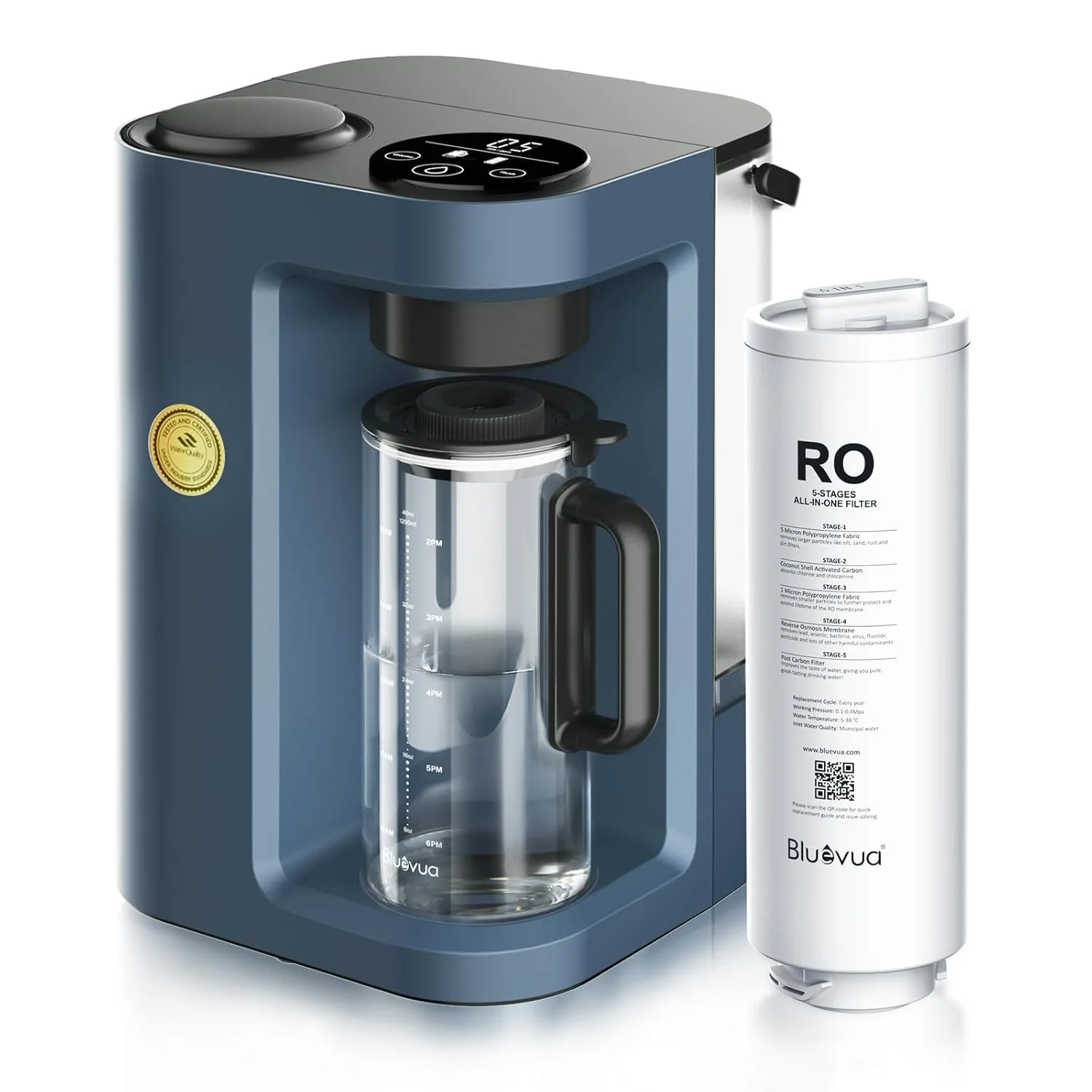
BLUEVUA RO100ROPOT-LITE Countertop RO
3.2L/hr output · 5-stage RO · LED indicators · No installation needed · Self-refilling design · Ideal for renters · AED-friendly filter costs
Perfect for tenants in UAE apartments who cannot make permanent modifications. Simply place on the counter and fill the reservoir — the RO system does the rest. Notably, one of the first countertop units to use genuine reverse osmosis rather than mere carbon filtration, making it one of the only portable solutions that actually handles the UAE’s high TDS water effectively.
AED 1,694: Free Delivery
Amazon UAE
🏠 Best Whole-House Solution
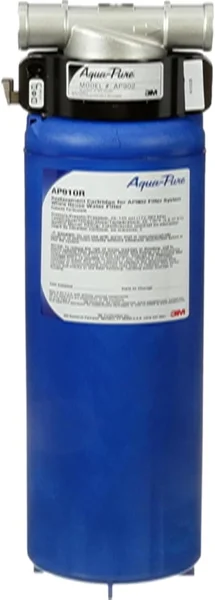
BLUEVUA RO100ROPOT-LITE Countertop RO
High-flow sediment + carbon · Covers entire home supply · Protects all appliances · Reduces chlorine, sediment, cysts · 1-year cartridge life · Professional install recommended
For villa owners in communities like Arabian Ranches, Palm Jumeirah, or Yas Island, treating water at the point of entry protects every appliance in your home — from the washing machine and dishwasher to showers and hot water systems. The 3M AP902 fits on the main supply line and dramatically reduces limescale and chlorine building-wide, significantly extending the life of your home appliances. Pair with an under-sink RO for drinking water.
AED 2,218: Free Delivery
Amazon UAE
💸 Budget Entry: Best Pitcher Filter
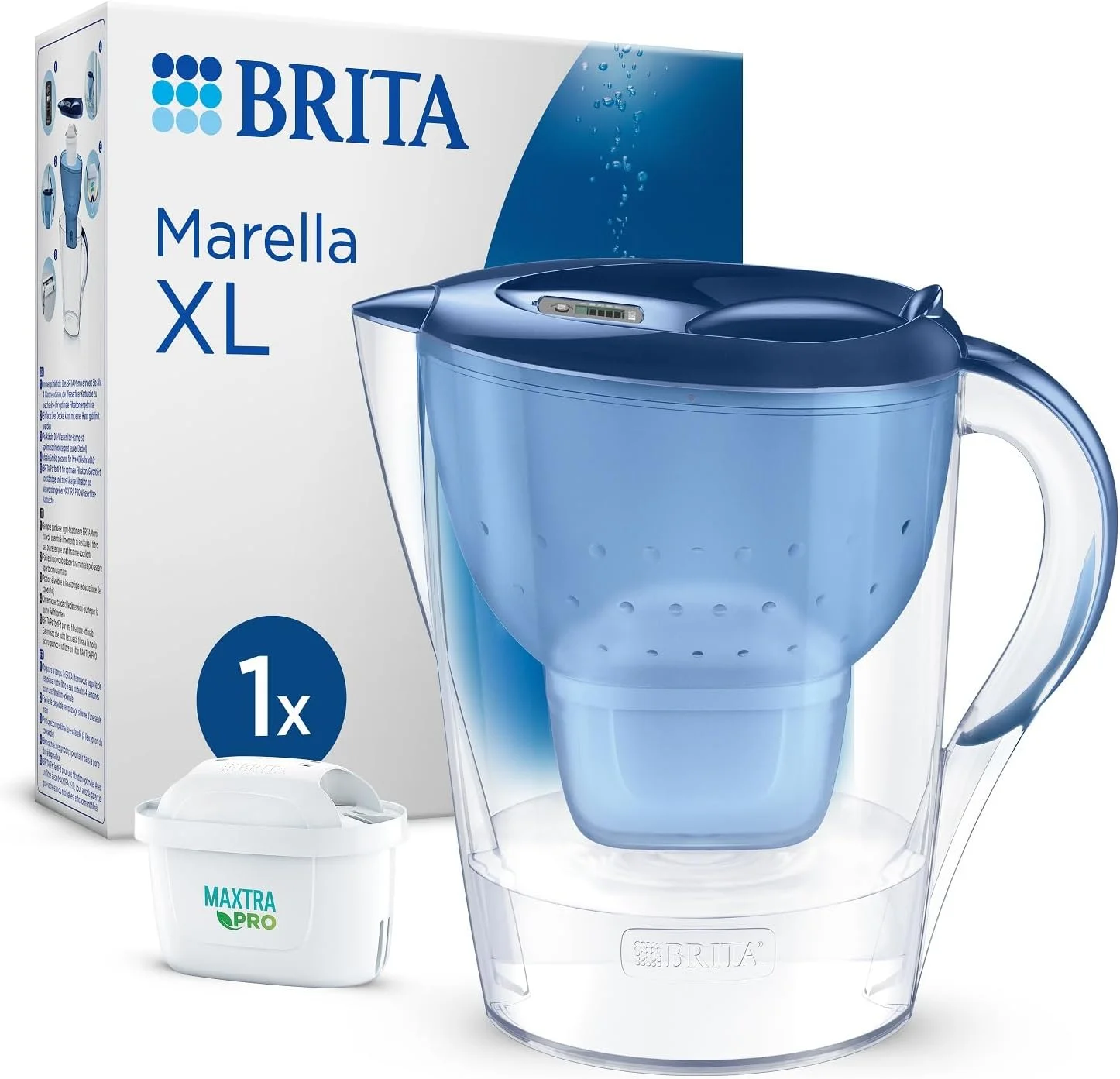
Brita Maxtra+ Large Water Filter Jug (3.5L)
3.5L capacity · Maxtra+ cartridge · Reduces chlorine, limescale taste, heavy metals · Cartridge lasts ~4 weeks · Fridge-friendly design · Available in white/grey
For villa owners in communities like Arabian Ranches, Palm Jumeirah, or Yas Island, treating water at the point of entry protects every appliance in your home — from the washing machine and dishwasher to showers and hot water systems. The 3M AP902 fits on the main supply line and dramatically reduces limescale and chlorine building-wide, significantly extending the life of your home appliances. Pair with an under-sink RO for drinking water.
AED 122: Free Delivery
Amazon UAE
Installing a Water Purifier in a UAE Apartment or Villa
Installing an under-sink RO system in a UAE home is a manageable DIY project for most adults — the process takes 45–90 minutes and requires only basic hand tools. Most systems sold on Amazon UAE and Noon come with full installation kits. Here’s a high-level overview:
🔧 Renter’s Note
If you’re renting in Dubai or Abu Dhabi, check your tenancy contract. Most UAE landlords allow under-sink filter installation as it requires minimal modification (a small hole in the sink for the dedicated faucet). However, always inform your property manager. Countertop units like the BLUEVUA require no permissions at all.
The standard under-sink RO installation involves: connecting a saddle valve to the cold water supply pipe under the sink, running a line to the filter unit, connecting the drain tube to the waste pipe, fitting the small dedicated faucet to the sink, and connecting the outlet to the storage tank. Most UAE fittings are standard 1/4-inch tubing compatible with international RO systems.
If you’re not comfortable with DIY plumbing, platforms like ServiceMarket and Bayut Home Services both list certified plumbers in Dubai and Abu Dhabi who will install most RO systems for AED 100–200, including all connections.
Maintenance: What UAE Owners Need to Know
Water purifier maintenance in the UAE requires more frequent attention than in countries with softer water. High mineral content clogs pre-filters faster, and the intense heat accelerates filter degradation. Use this schedule as your guide:
📅 UAE Maintenance Schedule
Every 3–4 months: Replace sediment pre-filter (faster in dusty seasons — September to November sandstorm period)
Every 6 months: Replace carbon block pre-filter
Every 12–18 months: Replace RO membrane (test TDS — if purified water exceeds 50 mg/L, replace sooner)
Every 12 months: Replace post-carbon and remineralisation cartridges
Every 12 months: Sanitise the storage tank with a food-safe sanitiser kit (especially important in summer — rooftop storage means incoming water can be warm, increasing bacterial risk)
Frequently Asked Questions
The Right Purifier for Every UAE Home
⭐ Our Final Verdict
The Right PFor the vast majority of UAE families — whether in a Dubai apartment or Abu Dhabi villa — the answer is a 5 or 6-stage under-sink RO system with remineralisation. Nothing else reliably addresses the UAE’s specific combination of high TDS, water hardness, chlorine treatment, and variable pipe quality.
Our top overall pick is the iSpring RCC7AK at AED 1,780 — it combines proven RO performance with the critical alkaline remineralisation stage, excellent UAE compatibility, and strong after-sales support. For the best value, the Geekpure 5 Stage Reverse Osmosis RO at AED 599 is exceptional. Renters who can’t install anything should consider the BLUEVUA countertop RO at AED 1,694 — a rare, genuinely portable RO solution.
💡 Quick Rule: If your TDS is under 300 mg/L → carbon filter is fine. 300–600 → standard RO. Above 600 mg/L → high-capacity RO with booster pump. Already spending AED 150+/month on bottled water? Any of our top 3 picks pays for itself within 6 months.